
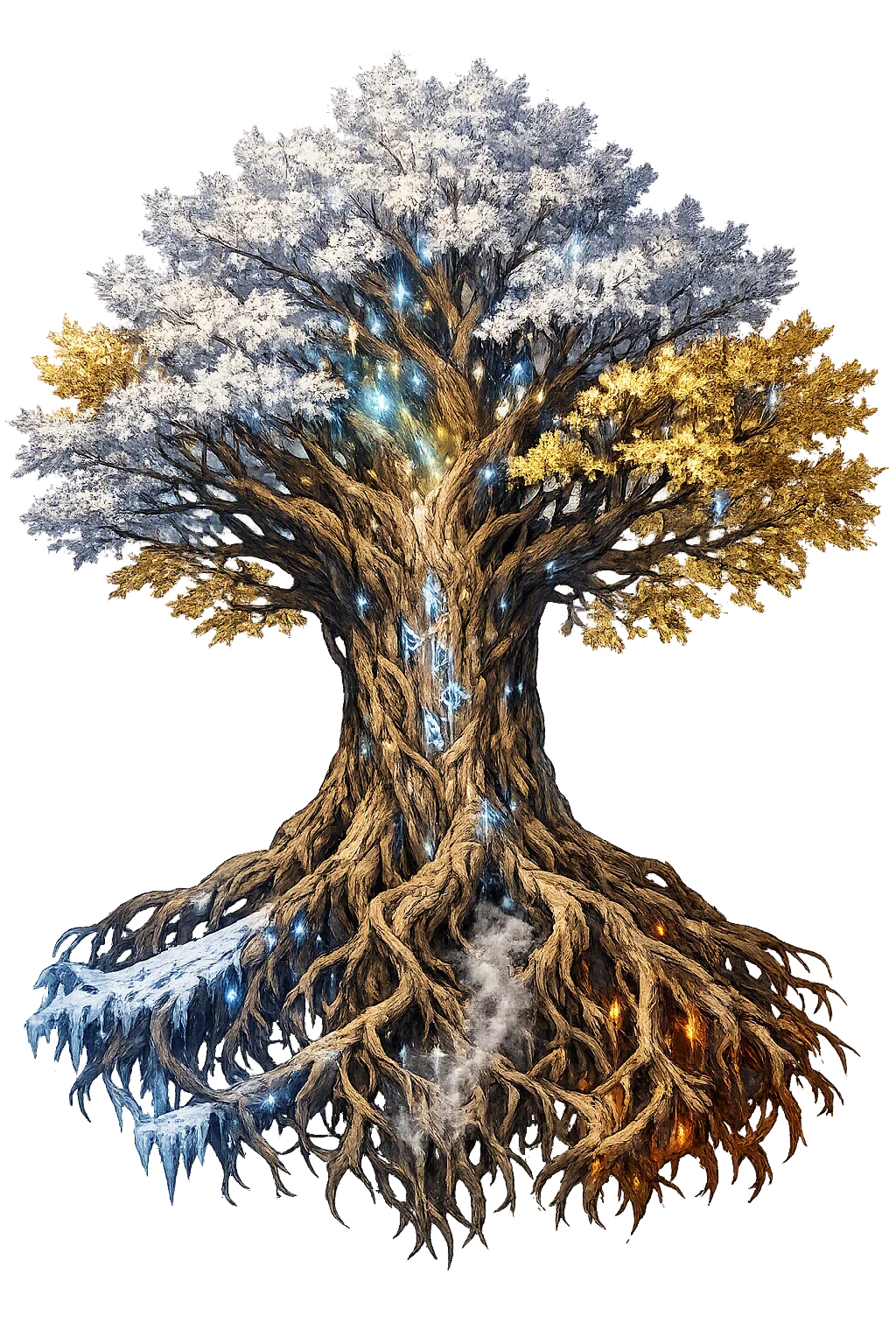
The canonical register: Yggdrasill
A letter to a colleague, 31 July 2026 — on the name Yggdrasill, and on the forms that keep failing it.
Your note said, roughly: surely the marks are a nicety. Permit me to use Yggdrasill to show they are not.
First, the attestation. The attested form is ᚢᚴᚴᛏᚱᛅᛋᛁᛚᛚ, from the tradition's own record. The canonical transliteration is Yggdrasill.
Say it aloud as the sources heard it: 'UEG-drah-sill' — the first vowel rounded like German ü, the double g and double l each held a fraction long, stress on the first syllable as in every Old Norse word. The marks are what carry that sound to a reader who has never heard it spoken.
On the plain form — and I want to be precise, because you pushed on this. The plain form yggdrasill differs from the canonical Yggdrasill only by convention of display — case, not content. It is acceptable everywhere: in legacy systems, in plain-text citation, in the DNS itself. What is not acceptable is what follows in the register: respellings that change the letters, not just their case.
Now to the forms that provoked your letter. As for yggdrasil: it comes from the anglicized respelling — the name written the way English guesses it sounds, and it fails because rewrites attested consonant clusters to fit English spelling habits; every cluster simplified this way erases a letter the sources write
One more thing, because it always surprises: the name did not stay home. Yggdrasill's truest parallels are cultic, and the closest stands at Uppsala. Adam of Bremen, writing about 1075 from the report of eyewitnesses at the Danish court, describes beside the temple a great tree, evergreen in winter and summer, its species unknown, with a spring where human sacrifices were drowned — a living cult-tree of exactly the kind the poems mythologize.
And it never stopped working. Yggdrasill's modern afterlife begins with the romantic rediscovery of the Eddas and hardens into icon with Wagner: in the Ring cycle the Welt-Esche, the World Ash, anchors the whole drama — Wotan has torn a branch from it to make the spear on which the treaties are carved, the tree withers when the wellspring is disturbed, and the Norns spin their rope beneath it in the prologue to Götterdämmerung. From Wagner onward the tree became the default emblem of Norse myth itself, the one image every popular retelling reaches for.
The Convention's Own History
The Poetic Edda survives essentially in one manuscript — the Codex Regius, c. 1270 — and normalized Old Norse spelling descends from what that manuscript and its siblings actually write. Þ and ð are not decorations: they are letters of the alphabet the skalds used (and English later abandoned), and ǫ is a nasal vowel the normalization preserves because the sources carry it. The register's rule is the manuscript's rule: spell the names the way the tradition that sang them wrote them down.
Where Protocol Meets Practice
The technical answer is simple: the canonical marks are legal IDNA 2008 characters, encoded as punycode under `xn--`. The practical answer is messier: legal does not mean stocked (registrar inventory is partial), and stocked does not mean typeable (stacked diacritics defeat mobile keyboards).
So the register's rule is a hierarchy of attested forms — full restoration, circumflex, macron-only, attested variant, and finally plain ASCII for the systems that cannot carry marks. Every rung is defensible because every rung is attested. The forms this register rules against are not rungs; they are errors, and errors do not get rungs.
Write back when you have checked the sources; they are better company than I am.
— The Register
The Verdict
Yggdrasill is the canonical form: attested, checkable, and enforced across the temple, the lexicon, the cards, the APIs, and this register. The plain form yggdrasill shares that standing — the two are the same name in every system. The false forms above are documented so that no reader has to take the temple's word on faith — the violations are stated, the sources are named, and the register stands open to challenge on every line.
The temple of Yggdrasill stands at /sites/yggdrasill/.
The docket for this ruling: 1 false form ruled against, yggdrasil first on the docket; no contested forms attested; the attestation rests on 6 cited sources — Poetic Edda: Völuspá 2 (mjötviðr, the measuring tree), 19–20 (the ash, the clay, the dew, the norns), 47 (the shuddering ash at Ragnarök); Grímnismál 29–35 (the three roots, the eagle and Veðrfölnir, Ratatoskr, the four stags, Níðhöggr, the tree's agony); Hávamál 138–141 (the nine nights on the windy tree); Vafþrúðnismál 44–45 (Líf and Lífþrasir in Hodd-Mímir's wood); Fjölsvinnsmál 19–26 (Mímameiðr), Snorri Sturluson, Prose Edda: Gylfaginning 8 and 15–16 (the ash, the three roots and three wells, the norns, the Æsir's daily court, Bifröst, the creatures, the watering); Skáldskaparmál (tree-kennings and þulur), Cleasby–Vigfusson, An Icelandic-English Dictionary, s.vv. Yggdrasill, drasill, Yggr (lexicon authority: 'Yggr's horse', the gallows-kenning).
The Register Continues
The register holds 397 entries like this one — each temple with its own ruling. Read the temple's founding dispatch for the story, its Restoration File for the philology, its Resonance File for the industries, or the whole archive end to end.
Continue the register — previous entry: Yánluó (read it) · next entry: Yīnyáng (read it).
The Canonical Register is written from the same canonical record as the lexicon itself. If a false form is missing from this page, it is because the evidence does not support calling it false — or because we have not seen it yet. Show us, with a citation, and the register will answer.