
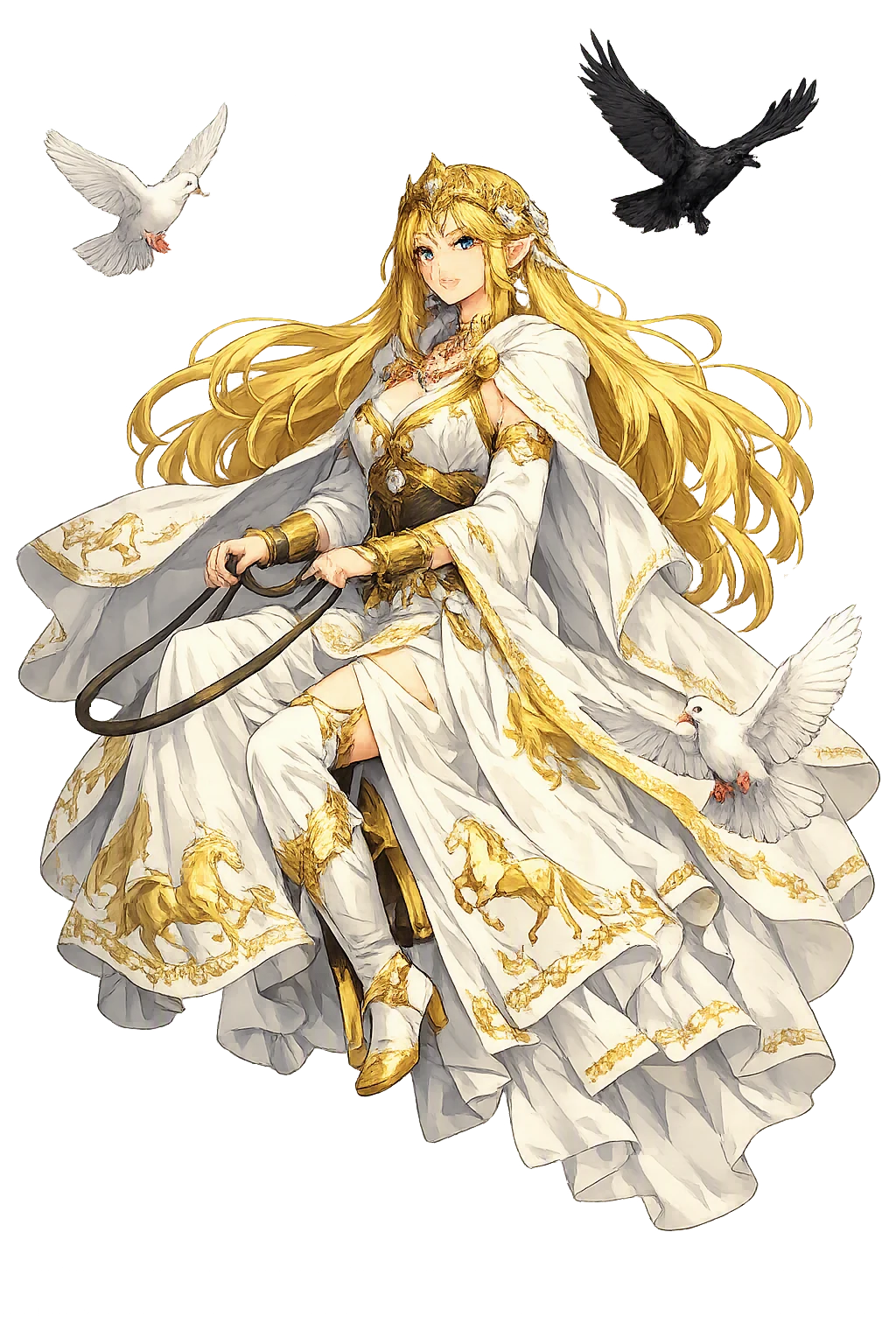
How Rhiannon got its accent back
The ASCII form rhiannon is missing something. Rhiannon restores the marks the source language used to distinguish this name from a thousand others — and those marks change how the name is read, pronounced, and understood. This post explains, with the full scholarly record behind it, what each restored mark preserves: the Celtic transcription evidence, the reconstructed sound, the myths the name carries, and the classification logic that separates Tier 1 restorations from Tier 2. By the end, the marks in Rhiannon will look less like ornaments and more like what they are — recovered evidence, pinned back in its proper place.
At a Glance
- Restored name: Rhiannon
- ASCII form: rhiannon
- Meaning: "Great queen"
- Domain of influence: Horses, Sovereignty
- Pantheon: Celtic
- Classification: Tier 2
Overview
Rhiannon (rhiannon) — Horses, Sovereignty · Great Queen — is the central female figure of the Four Branches of the Mabinogi, the queen of Dyfed who rides past Gorsedd Arberth on a pale horse at a pace no mounted pursuit can close, and who bears a false accusation and an unjust penance without once surrendering her dignity.
Her name is a scholarly reconstruction made flesh: Celticists derive Middle Welsh Rhiannon from Common Celtic Rīgantonā, 'great queen, divine queen', from rīgan- 'queen' — Old Irish rígan is the exact cognate — and the figure matches the title. She appears in three of the Four Branches: in the First, Pwyll Pendefig Dyfed, she chooses Pwyll for her husband, out-plots the unwanted suitor Gwawl, loses her newborn son to a May-eve marvel, and endures the penance of the horse-block until the boy is restored and named Pryderi from her own word of relief; in the Second, Branwen ferch Llŷr, her birds — Adar Rhiannon — sing to the seven survivors across the sea; in the Third, Manawydan fab Llŷr, she is caught in the enchantment of Dyfed and comes home wearing the collars of asses, still a queen.
PuniCodex restores the name as Rhiannon — identical to the ASCII input, because Middle Welsh writes the name in plain Latin letters with no diacritic for the restoration to recover; the name is Tier 2 by the mechanical rule. The plain-ASCII rhiannon.com is held by a third party outside the PuniCodex collection and is watched for release; no form of the name is currently owned, and this temple claims none.
The Name
The name is attested in Middle Welsh as Rhiannon, daughter of Hefaidd Hên (Heyfaidd the Old), in the Four Branches of the Mabinogi. The standard etymology is a reconstruction: Common Celtic Rīgantonā, built on rīgan- 'queen' — the exact cognate of Old Irish rígan and relative of Welsh rhiain 'maiden, noble lady, queen' — with a suffix marking the divine or intensified form, hence the traditional gloss 'Great Queen' or 'Divine Queen'. The reconstruction is the consensus of the handbooks, but it is a reconstruction: no ancient inscription preserves the longer form, and honest scholarship labels it accordingly.
The ASCII form is not a compromise here: Middle Welsh writes the name in plain Latin letters, and the normalized spelling is already Rhiannon. There is no diacritic and no distinctive letter for the restoration to recover; only the capital distinguishes the restored form from the input, which places the name in Tier 2 by the mechanical rule.
The letter-by-letter transformation runs:
- r → R — Same, capitalized
- h → h — Same
- i → i — Same
- a → a — Same
- n → n — Same
- n → n — Same
- o → o — Same
- n → n — Same
The project holds no domain for this name: rhiannon.com is registered to a third party outside the PuniCodex collection and is watched for release. The temple is served at /sites/rhiannon/ and claims no domain it does not hold.
The Original Script
The name is preserved in Middle Welsh manuscripts in the Latin alphabet as Rhiannon — Middle Welsh (Brythonic Celtic), attested in the White Book of Rhydderch (c. 1350) and the Red Book of Hergest (c. 1382–1410), recording material composed centuries earlier. The script is written left-to-right in the medieval Welsh bookhand.
The scholarly rendering proceeds step by step:
- Middle Welsh writes the name in plain Latin letters; the digraph rh represents the voiceless trill [r̥] that the language still keeps.
- No diacritic attaches to the name in any witness: normalized Middle Welsh orthography and the ASCII spelling are identical.
- The deeper form Rīgantonā is a modern philological reconstruction from Common Celtic rīgan- 'queen' (Old Irish rígan, Welsh rhiain), not an attested manuscript spelling.
- The Unicode restoration Rhiannon therefore changes nothing but the capital; the name stands in Tier 2 by the mechanical rule, and the plain-ASCII domain rhiannon.com — held by a third party outside the PuniCodex collection and watched for release — is the philologically complete form.
Pronunciation
The pronunciation of the name in Modern Welsh is /r̥iˈa.nɔn/ — Modern Welsh; the Middle Welsh value is held to be substantially the same.
Phoneme by phoneme:
- Rh- — Voiceless alveolar trill [r̥]: the Welsh digraph rh writes an r sounded with breath, a phoneme English lacks; the usual approximation 'hr' is only a crutch
- -i- — Short close front [i] in the light, unstressed first syllable
- -an- — Open [a] under stress: Welsh words are stressed on the penultimate syllable, so the weight of the name lands here
- -non — Alveolar nasal [n], the Welsh open-mid [ɔ], and the final [n]; the unstressed ultima closes quietly
For the modern speaker, the closest approximation is: 'hree-AH-non' — a breathy, whispered r at the start, the stress on the middle syllable.
Kindred and historical forms of the name:
- Middle Welsh — Rhiannon, daughter of Hefaidd Hên, queen of Dyfed
- Common Celtic (reconstructed) — Rīgantonā, 'great queen, divine queen'
- Old Irish cognate — rígan, 'queen'
- Modern Welsh — rhiain, 'maiden, noble lady, queen', the living relative
Rhiannon is Tier 2 by the mechanical rule: the Middle Welsh form is already plain ASCII, and the restoration preserves nothing the ASCII form loses. The reconstructed etymon 'Great Queen' belongs to the philological record, not to the spelling: the name's information-richness is semantic, not orthographic.
Mythology
Rhiannon's mythology is the strongest sustained portrait of a woman in medieval Welsh prose, and it is told almost entirely in the First and Third Branches of the Mabinogi, with one luminous cameo in the Second.
The Rider No Horse Can Catch (First Branch, Pwyll Pendefig Dyfed)
Pwyll, prince of Dyfed, goes up to Gorsedd Arberth — the mound where a man either suffers blows or sees a wonder — and sees a lady in shining gold brocade riding past on a great pale horse, at a slow and even pace. He sends his swiftest rider after her; the faster the pursuit, the farther she draws ahead. It happens again, and again, until Pwyll himself spurs his horse nearly to foundering and at last calls out: 'Maiden, for the sake of the man you love best, wait for me.' She stops at once: 'I will wait gladly — and it would have been better for the horse had you asked me that long ago.' She is Rhiannon, daughter of Hefaidd Hên, and she has come of her own will: she is being given to a man against her desire, and she has chosen Pwyll.
The Bag That Would Not Fill (First Branch)
At the wedding feast Pwyll grants a request before hearing it, and the petitioner is Gwawl fab Clud, the suitor Rhiannon refused, who claims her by the promise. Rhiannon devises the counter-plot: a year later Pwyll comes to Gwawl's feast as a beggar asking only that a certain small bag be filled with food. The bag cannot be filled until a true lord treads the food down and declares it enough; Gwawl rises to do so, Pwyll draws the bag shut over him, and his war-band falls on the hall, striking the bag and asking what is in it — 'a badger' — the origin of the game called Badger in the Bag. Gwawl renounces his claim and gives sureties; Rhiannon marries the man she chose.
The May-Eve Vanishing and the Horse-Block (First Branch)
After three childless years the nobles press Pwyll to take another wife; he begs one year more, and Rhiannon bears a son. On the birth-night the six watching women all fall asleep, and the child vanishes. Fearing blame, they kill a hound's pups, smear the blood on Rhiannon's face, lay the bones beside her, and swear she destroyed her own child. Pwyll will not put her away, but a penance is imposed: to sit beside the horse-block at the gate of Arberth, tell her story to every traveller, and offer to carry guests and strangers to court on her back. She accepts a sentence she did not earn, and bears it.
The child has fallen into the strangest rescue in Welsh prose. Teyrnon Twrf Liant loses a foal every May-eve; keeping watch, he strikes off a great clawed hand that reaches through the window for the newborn foal, and outside the door finds a baby wrapped in silk brocade. He and his wife rear the boy as Gwri Wallt Euryn, Gwri of the Golden Hair, who grows with uncanny speed into the very likeness of Pwyll. When Teyrnon hears of Rhiannon's penance he brings the boy to Arberth; Rhiannon says that if this is true, her pryder — her care, her anxiety — is lifted from her, and from that word the boy is named Pryderi. The penance ends.
The Enchantment of Dyfed (Third Branch, Manawydan fab Llŷr)
After Pwyll's death Rhiannon is given in marriage to Manawydan fab Llŷr, and with Pryderi and his wife Cigfa the four return to Dyfed. A peal of thunder and a fall of mist empty the land of people, dwellings, and beasts. They live by hunting, then by saddlery, shield-making, and shoemaking in England, driven from each town by craftsmen who cannot match their work. Back in empty Dyfed, a shining white boar leads Pryderi and Manawydan to a fortress that was never there; Pryderi takes hold of a golden bowl hanging by chains above a marble fountain and is rooted, dumb, to the spot. Rhiannon goes in after him, grasps the same bowl, and is trapped beside him — and fort, bowl, and prisoners vanish.
Manawydan undoes the spell by patience: he catches one slow mouse among the hordes stripping his wheat, condemns it to hang as a thief, and refuses the ransom offered in turn by a clerk, a priest, and a bishop until his price is met — Pryderi and Rhiannon released, the enchantment lifted, no vengeance. The mouse is the wife of Llwyd fab Cilcoed, transformed with his household; Llwyd had laid the spell to avenge his friend Gwawl. Pryderi comes home with the gate-hammer about his neck, and Rhiannon with the collars of asses about hers — the second humiliation she wears like a queen, and the second she survives.
The Birds of Rhiannon (Second Branch, Branwen ferch Llŷr)
Rhiannon never steps on stage in the Second Branch, but her birds do. The seven survivors of the Irish war, bearing the wounded head of Brân the Blessed, feast at Harlech for seven years, and three birds — Adar Rhiannon — begin to sing to them: every other song seems unlovely beside it, and though the birds are far out over the sea, their singing is as clear as if they sang in the hall. The song accompanies the company through the eighty years at Gwales in Penfro, until the forbidden door toward Cornwall is opened and sorrow returns. Later Welsh tradition says the song of the Adar Rhiannon wakes the dead and lulls the living to sleep.
Symbols & Iconography
The iconography of Rhiannon is narrative rather than cultic — medieval Welsh prose preserves no temple regalia, but the Four Branches fixed a small set of attributes around her:
- The pale horse — The great pale mount she rides past Gorsedd Arberth at an even pace no pursuit can close: sovereignty that arrives when it chooses, not when it is chased
- Gorsedd Arberth — The mound above the court where whoever sits receives blows or sees a wonder: the threshold between Dyfed and the Otherworld
- The bottomless bag — The small bag that will not fill until a true lord treads it down: her counter-plot against Gwawl, and the origin of the game of Badger in the Bag
- The horse-block — The marble mounting-block at the gate of Arberth where she sits out her penance and offers to carry guests to court on her back: dignity under a false sentence
- The collars of asses — What she wears about her neck when the enchantment of Dyfed releases her: the humiliation of the Third Branch, endured like a queen
- The three birds — Adar Rhiannon, whose song over the sea is clearer than any earthly music: the Otherworld made audible
Archaeology & Evidence
No cult site, votive deposit, or inscription of Rhiannon is known; her attestation is entirely literary, and the reconstructed *Rīgantonā has no epigraphic witness anywhere in the Celtic world. Her evidence is manuscript evidence. The Four Branches survive complete in the White Book of Rhydderch (Aberystwyth, National Library of Wales, Peniarth MSS 4–5, c. 1350) and the Red Book of Hergest (Oxford, Jesus College MS 111, c. 1382–1410), with earlier fragments in Peniarth 6; the tales themselves are dated by debate rather than document, most often to the later eleventh or early twelfth century.
The geography of her story is real: Arberth, the chief court of Dyfed, stands by modern Narberth in Pembrokeshire, and the mound tradition attaches to the country around it — but no sanctuary of hers is known. The nearest material horizon is comparative, not hers: the dedications to the Gaulish horse-goddess Epona recovered by the hundred across the Roman west, against which scholars have long read the rider of Arberth.
Realm & Domain
Rhiannon is the Great Queen of the Mabinogi: the Otherworld rider who chooses her own king, the mother who endures a false charge, and the captive who survives the enchantment of Dyfed.
Sovereignty
She is the land's queen in the oldest sense: she appears unbidden at the mound of Arberth, names the man she will marry, and her union with Pwyll stands in the long Celtic pattern in which kingship is conferred by the woman of the territory.
Horses
Every turn of her story is bound to the horse: the pale mount no rider can overtake, the foal born the night her son is stolen, the horse-block of her penance, and the collars of asses she wears out of the enchantment. Scholars have long read her against the Gaulish horse-goddess Epona.
Endurance
Twice she is sentenced to humiliation she did not earn — the false accusation of the serving women, the spell of Llwyd — and twice she endures it without breaking, until the truth arrives on its own legs.
The Otherworld's Music
The Birds of Rhiannon, Adar Rhiannon, sing to the survivors of the Irish war: a song far over the sea yet clear as if near, which later tradition credits with waking the dead and lulling the living to sleep.
Across Cultures
The great comparative debate pairs Rhiannon with Epona, the Gaulish horse-goddess whose two hundred and more dedications make her the best-attested Celtic deity of the Roman west. A queenly rider whose every story is bound to horses, whose name the handbooks reconstruct as 'Great Queen', looks very like an insular reflex of the mare-goddess; Mac Cana argues the parallel and Koch registers it as the standard comparison — but no inscription names Rhiannon or *Rīgantonā, and the identification remains typological, not epigraphic.
The second frame is sovereignty. Mac Cana reads the First Branch against the Irish pattern in which the land's queen chooses and validates the king, so that Pwyll's marriage to Rhiannon is his investiture as much as his wedding. The third comparison is with the Irish Macha, the sovereignty figure forced to race the king's horses: horse, humiliation, and queenship cluster around both women, and the handbooks have compared them for a century. None of these parallels is an identity; together they map the kind of goddess the Welsh prose is remembering.
Within the corpus, closely related figures include Pryderi (her son, the only child of the Four Branches whose story spans all four), Manawydan (her second husband, the patient undoer of the enchantment), and Arawn (the Otherworld king of Annwfn whose friendship with Pwyll opens the First Branch).
Cultural Legacy
Lady Charlotte Guest's translation of the Mabinogion (1838–49) carried Rhiannon out of the Welsh manuscripts and into the English-speaking world, and the Victorian Celtic revival made her one of the best-known figures of Welsh tradition. Evangeline Walton's twentieth-century retellings of the Four Branches, beginning with The Virgin and the Swine (1936) and completed in the Mabinogion tetralogy, kept her before modern readers as the proud queen of Dyfed.
In 1975 Fleetwood Mac's 'Rhiannon' — written by Stevie Nicks, who took the name from a novel and only afterwards learned that it belonged to a Welsh goddess — made the name famous worldwide; the given name Rhiannon, already living in Wales, spread across the English-speaking world in the song's wake. In modern Druid and pagan practice she is honoured as a goddess of horses, sovereignty, and endurance under injustice, and scholars of the Mabinogi rank her among the most fully realized women in medieval European literature — a figure whose dignity the prose never once allows to slip.
A Meditation
Rhiannon cannot be caught because she has already decided where she is going. The fastest horses in Dyfed gallop themselves to exhaustion behind a rider who is barely trotting — and the moment she is asked, she stops, because stopping was always hers to give. That is the secret the First Branch teaches about power: the pace of a sovereign is not set by her pursuers.
The rest of her story tests the lesson. Falsely accused, she does not rage or plead; she sits down by the horse-block and carries her guests, one by one, until the truth walks home on its own legs. Trapped in the enchantment, she endures the collars of asses and comes out still the Great Queen. Endurance, in her telling, is not passivity — it is the refusal to let an unjust sentence write your name. She waits, she carries, she outlasts; and the land is hers again.
The Unicode Restoration
Rhiannon is classified as Tier 2: the restoration needs no distinctive letters or diacritics its ASCII form would lose. The ASCII fallback rhiannon still resolves everywhere, but it is the restored form that carries the name's full information. That is the whole thesis of this temple: the marks are the message.
Why This Restoration Matters
The marks in Rhiannon were never lost; they were only waiting for a carrier that could hold them. Now that the carrier exists, the burden flips: every use of rhiannon is a choice to leave evidence on the table. The PuniCodex temple keeps the restored form in circulation — as a domain, a dataset entry, and a scholarly argument — so that the choice to use it stays easy. Accent by accent, macron by macron, that is how the original names come back: not with a single grand gesture, but with a spelling that finally works everywhere.
Explore Further
This post is one doorway into the temple. The home page carries the full character breakdown and the ambient canvas; the lore page tells the myths in long form; the Scholarly Edition preserves the sources, pronunciation data, and revision history; and the patron wall supports the restoration directly. For the wider map, browse the Lexicon, explore the Pantheon, or return to the PuniCodex blog.
Related Names
Sources
The full scholarly apparatus — every citation, revision, and review — lives in the Scholarly Edition. Key references for this post:
- The Mabinogi, First, Second, and Third Branches, trans. Sioned Davies (Oxford: Oxford University Press, 2007).
- Koch, John T., ed., Celtic Culture: A Historical Encyclopedia (Santa Barbara: ABC-CLIO, 2006), s.v. Rhiannon; MacKillop, James, Dictionary of Celtic Mythology (Oxford: Oxford University Press, 1998), s.v. Rhiannon.
- PuniCodex domain register for this entry: rhiannon.com held outside the collection, watched for release; temple served at /sites/rhiannon/.
- Koch, John T., ed., Celtic Culture: A Historical Encyclopedia (ABC-CLIO, 2006), s.v. Rhiannon; MacKillop, James, Dictionary of Celtic Mythology (Oxford, 1998), s.v. Rhiannon.
- Lexicon authorities for this entry: Mabinogion, MacKillop.